Sunday, January 8, 2012

T. S. Eliot's "The Journey of the Magi"

When my mind needs to be refreshed and stimulated all at once, I turn to poetry.  The dance of well written imagery is soothing to me, and the thoughts those images inspire are vivifying.

Many of my students object to Eliot after their initial introduction to him.  His religious images are too tense or dark for them; perhaps he touches their own conflicts, which they'd rather have smoothed away in the intellectual intrigues of the Metaphysicals or the rollicking fancies of the Romantics.  I love to use this poem to show them that Eliot always has a shadowy sort of hope in his post-baptismal poetry, even when he remains brutally honest about the struggles of living in the modern world.

Here are some (very brief!) reflections on his poem, appropriate for Epiphany today . . . the italicized words are his own.  He composed it shortly after his own baptism (a very difficult period in his life).
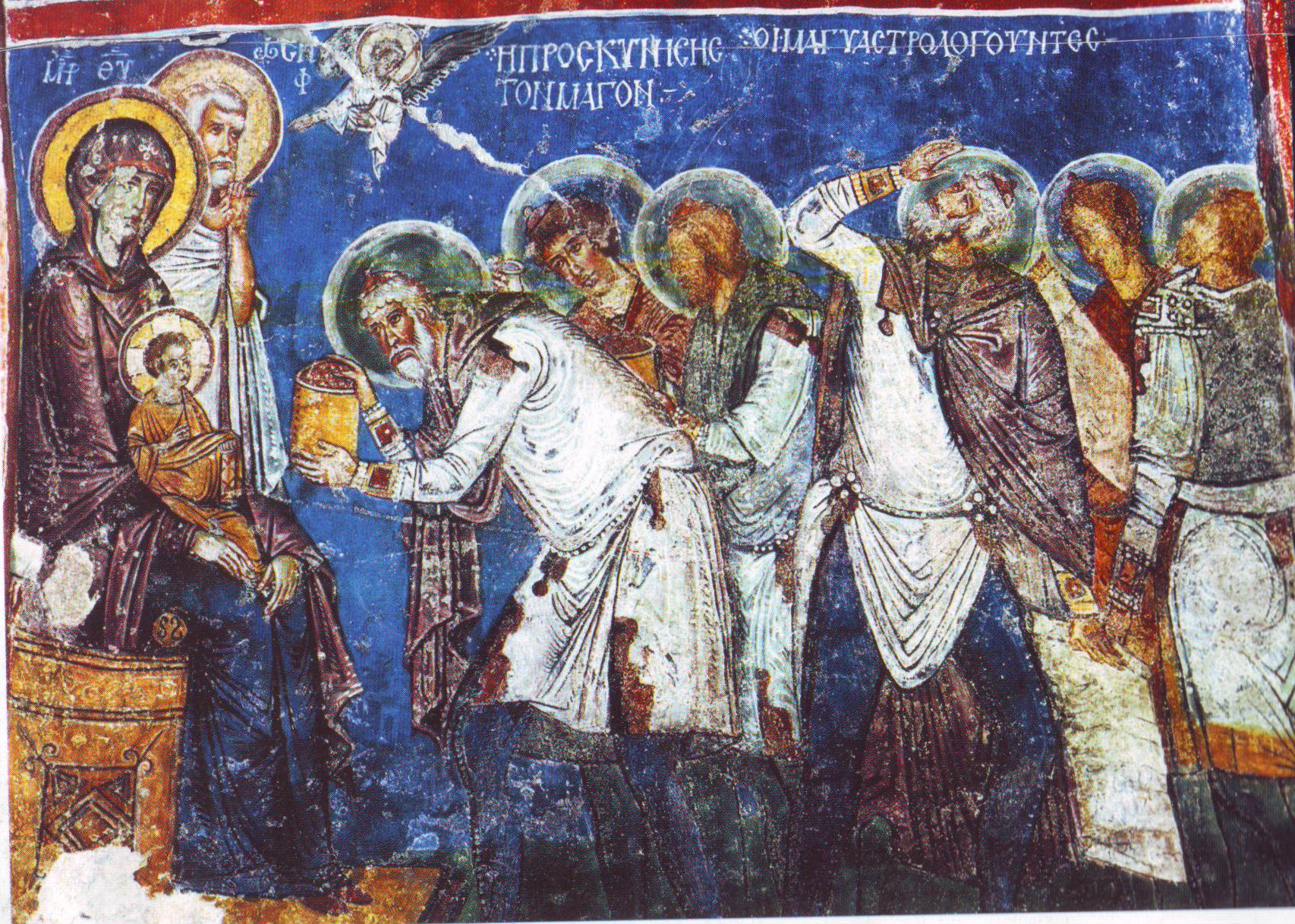
I like these magi; they look beat up from the journey, as Eliot describes.

'A cold coming we had of it,
Just the worst time of the year
For a journey, and such a long journey:
The ways deep and the weather sharp,
The very dead of winter.'
And the camels galled, sore-footed, refractory,
Lying down in the melting snow.
There were times we regretted
The summer palaces on slopes, the terraces,
And the silken girls bringing sherbet.
Then the camel men cursing and grumbling
And running away, and wanting their liquor and women,
And the night-fires going out, and the lack of shelters,
And the cities hostile and the towns unfriendly
And the villages dirty and charging high prices:
A hard time we had of it.
At the end we preferred to travel all night,
Sleeping in snatches,
With the voices singing in our ears, saying
That this was all folly.


 No fresh-faced kings with smiling servants here . . . the Magi, like us during the Advent season, have left behind a comfortable, materialistic life [There were times we regretted . . .] in favor of a pilgrimage to a new life, a new truth.  Even their companions on the journey are disloyal [running away] and unfocused [wanting their liquor and women.]  Amidst the difficulties, the worst are the voices in their own minds that wonder if eschewing the world and taking this hard path is really worth it after all.

Then at dawn we came down to a temperate valley,
Wet, below the snow line, smelling of vegetation;
With a running stream and a water-mill beating the darkness,
And three trees on the low sky,
And an old white horse galloped away in the meadow.
Then we came to a tavern with vine-leaves over the lintel,
Six hands at an open door dicing for pieces of silver,
And feet kicking the empty wine-skins.
But there was no information, and so we continued
And arrived at evening, not a moment too soon
Finding the place; it was (you may say) satisfactory.


These images are beautiful and rich with meaning!  I'll focus your attention on a couple.  As they approach the Christ-Child, the world is temperate and thus fruitful (or potentially so).  Yet, the people there have "no information;" they are oblivious to the deeper happenings nearby.  At the same time, many of the landmarks portend dark things--the water mill is seen contending against the "darkness" and the "three trees" on the horizon portend Christ's own death on a tree with the two criminals at his side.  I also like that they find the stable "satisfactory;" they do not fall into superfluous praise or a panegyric on the irony of a god placed in a manger.  At the same time, these magi do not decide finally that "this was all folly" because the stable is merely "satisfactory" at best.  Implied may also be the sense that anything God chose for his Son must be "satisfactory" and beyond our human scale of judgement to declare otherwise.

All this was a long time ago, I remember,
And I would do it again, but set down
This set down
This: were we led all that way for
Birth or Death? There was a Birth, certainly,
We had evidence and no doubt. I had seen birth and death,
But had thought they were different; this Birth was
Hard and bitter agony for us, like Death, our death.
We returned to our places, these Kingdoms,
But no longer at ease here, in the old dispensation,
With an alien people clutching their gods.
I should be glad of another death.


A true experience of God is not easily forgotten and must be shared, as the author's insistence to "set down / This" indicates here. The next reflection on the blending of Birth and Death in the same event reminds me of Donne's very different treatment of the same theme in "Upon the Annunciation and Passion Falling Upon One Day."  Christ's Birth began the sacrifice that culminated in His innocent Death.  Our own participation in the life of Christ and our initiation in Baptism grants us a re-birth in the spirit, but that re-birth is also a death to the old self and an invitation to carry Christ's cross along with Him in this life.  The Magi witnessed the Infant Christ.  Yet, this event and their ratified belief for which they now have "evidence" from a personal encounter with God has made them strangers in their own homes.  The people they shepherded previously are "alien" to them, and the magi have the insight now to see that their faith in pagan gods is desperate.  The life of a follower of Christ is often a path of rejection; in so far as we stand up for our beliefs, we may also find that "no prophet is accepted in his own country."  But here is Eliot's sense of hope . . . the author, in the final analysis, would be "glad of another death."  Whether this refers to another meeting with Christ and metaphorical death to self or to the author's final, physical death and reunion with his Maker, it is worth the cost.  If the world sees this choice as "folly," the wise men have learned that "the foolishness of God is wiser than man's wisdom, and the weakness of God is stronger than man's strength" (1 Cor 1:25).


Image source

Sunday, January 1, 2012

A Resolution for Meaning

Often on this celebration of yet another trip around the sun, we think about the ways we can add health or productivity or efficiency to our lives.  I was surprised and inspired by Pope Benedict's unusual challenge given in his homily today:

Another year is drawing to a close as we await the start of a new one: with some trepidation, with our perennial desires and expectations. Reflecting on our life experience, we are continually astonished by how ultimately short and ephemeral life is. So we often find ourselves asking: What meaning can we give to our days? What meaning, in particular, can we give to the days of toil and grief?

He does not promise an end to "toil and grief" or a longer life as a result of our new year's resolutions.  Instead, he asks us to bring meaning to the state of life in which God has placed us.  Honestly, I find this a much harder goal to make and follow than a vague promise to myself to work out more or clean that garage out for once.

Pope Benedict XVI, always applying his philosophy and theology to daily living, has several recommendations regarding how we might add meaning to our lives:


  • Turn to Christ.  "Man is son of a God who has entered time so as to redeem it from meaninglessness and negativity, a God who has redeemed all humanity, giving it everlasting love as a new perspective of life."  Love, thus, is the key to anxiety and brokenness.  A very holy monsignor gave our homily today at Mass.  He encouraged us to pray for ourselves, but also to pray fervently for others in this new year.  We need grace to achieve peace and to live our lives after the example of Christ.


  • Embrace evangelization.  Witnessing to Christ within you is not someone else's job.  Pope Benedict specified that the youth today are particularly aware of the evils of society.  They are not guarded from the ways our world is broken, and they are particularly sensitive to the despair that can come from a recognition of evil.  Families have the first priority toward showing them the hope that can be found in Christ.  If a child sees that the evils of the world only penetrate his parent's peace to a small extent because of that parent's trust in God's goodness, that child may also learn to believe that God is beyond the anxieties of the present.  He cites both the Sacraments and the formal instruction of the faith as additional practical ways to bring your child closer to Christ.


  • Be grateful.  The pope's final exhortation is to be grateful.  Sometimes the most prominent events from a particular year are trials rather than blessings.  Yet in so far as we can recognize that God's Providence is at work at all times in our lives, we can have a joy that abides deeper than any passion or experience can touch.  Edith Stein speaks of this phenomenon in her discussion on the passions.  She says that some people, especially people of faith, have a core that is joyful or peaceful.  They still experience normal passions: fear, anger, etc.  However, those negative passions only have a limited "reach" into the depths of the person.  A person's core can repel and overcome negative passions and reestablish equanimity in his life (or at least in the perspective he holds in relation to the events of his life.)  I've always loved St. Paul's reflections on gratitude as a prerequisite for peace:


  • Do not worry about anything, but in everything by prayer and supplication with thanksgiving let your requests be made known to God. 7 And the peace of God, which surpasses all understanding, will guard your hearts and your minds in Christ Jesus.8 Finally, beloved, whatever is true, whatever is honorable, whatever is just, whatever is pure, whatever is pleasing, whatever is commendable, if there is any excellence and if there is anything worthy of praise, think about these things. Keep on doing the things that you have learned and received and heard and seen in me, and the God of peace will be with you. -- Philippians 4:6-9


    I'll end with a final quotation from our Holy Father:

    . . . we must see to it that the beauty and contemporary relevance of the faith is rediscovered, not as an isolated event, affecting some particular moment in our lives, but as a constant orientation, affecting even the simplest choices, establishing a profound unity within the person, so that he becomes just, hardworking, generous and good.

    To be a united person, not fragmented and frenzied . . . to find that unity in the One God.  What a beautiful new year's resolution!  I think I'll work on ending every day with a reflection on that idea.  "Was I oriented towards Christ or towards myself today?  Despite any difficulties that I encountered, was I hardworking, generous, and good?  Did I have a spirit of gratitude or of joyful acceptance?"  And perhaps if I truly seek out those few things, the rest will follow and I will grow a bit closer to the heart of my Lord.

    Jesus, meek and humble of heart, make my heart like Thine!

    Read the pope's full homily here: http://www.ncregister.com/daily-news/pope-gives-thanks-to-god-for-2011/#ixzz1iEsbXI1k

    Image source

    Tuesday, December 20, 2011

    Silent Night

    Silence is pretty much the last word I would generally associate with my childhood experiences of Christmas.  Singing, yes.  Laughter (that of my 40+ cousins and second cousins etc. and egg-nog enjoying uncles and older cousins), yes.  Ripping paper as our "let's open one at a time" plan fails yet again, yes.  Silence, not so much.

    However, I married a man that values silence or quiet immensely in his daily life and especially in regards to religious celebrations and holidays.  That is certainly not to say that he doesn't enjoy being surrounded by family.  He just doesn't like all the extra distracting noise that often times comes with the Christmas season (especially incessant chipmunk versions of Christmas carols blasting across every radio station).

    I tend to get caught up in the noise--it helps provide the excitement I sometimes don't feel as I do chores around the house, or in the case of music, it almost keeps me company at times.  I have to work to value silence and to create silent times in my life.  Once I do, I love it.  I just have to stop the continual whir in my head for long enough to relax, and then the silence is, quite honestly, heavenly.

    If you're like me, perhaps you too will find this  reflection by the Bishop of Aberdeen to be just about perfect as I did.

    Things that struck me from the article linked above:
    • The Kierkegaard quotation: "And even if it were trumpeted forth with all the panoply of noise so that it could be heard in the midst of all the other noise, then it would no longer be the Word of God."
      • Wow!!!  Yet, so true.  God is not a commercial product to be advertised.  He is a person to be known and adored.  I think this phenomenon is why the "facebook b/t Joseph and Mary" video bothers me so much.  It almost trivializes the Birth of Christ to have Him announced the way any party or product would be at this time of year.  God sent angels to sing His praise.  The least I can do is to sing His praise with my family--reading the story of the Incarnation to my little guy, placing our nativity set in a place of honor, and distancing myself from the temptation to materialism that threatens to invade every gift given to honor a friendship or loved one.
    • The verse from Wisdom 18:14-15, "When a deep silence covered all things and night was in the middle of its course, your all-powerful Word, O Lord, leapt from heaven's royal throne."
      • As a confirmed logophile, I can't even express how beautiful this imagery is!  It rivals anything drawn by the best poets of our language.
      • As a Christian, I find so much to reflect on here that in the midst of silence and night, God speaks His saving Word.  And He speaks it with a joy that leaps to take a humble place as a lowly human in a stable.  How much more should I be jumping to seize opportunities for humility and service in my life if this is my model and my Creator??
    • The reflections on praying before and after Mass.
      • For many years this too was my constant habit.  I craved the time for reflection before and after receiving my Lord and Savior.  Now, we're lucky to get to Mass several minutes beforehand and get JT somewhat settled before the service starts.  At the end, JT is ready to sprint out the door (and so is whichever parent he has frustrated the most during Mass as we try to teach him to be still and quiet during Mass).  I still desire that time for reflection, but I'm not sure that I'm going to get it at Mass while my children are little.  It's starting to make more and more sense why my mom has sacrificed sleep for years to wake up early to pray and work out--if that's really a priority and need in her life, that's the only time it's going to happen!
    • "Christ looks for silence."
      • This Christmas I'm going to seek to give the Christ-child a silent heart.  A heart that is waiting for Him expectantly and without murmuring voices of complaint, sarcasm, and criticism sneaking in to invade.  And I think that will take more preparation for me in this last week than all my other gifts combined . . .
    Image source