Showing posts with label Literature. Show all posts

Sunday, August 26, 2012

The Red Balloon (1956 film): A Misunderstood Eucatastrophe & the Christian Ethos of Hope

Midnight found me slumped on the bathroom floor, totally forgetting my illness as, mesmerized, I watched The Red Balloon (Le Ballon Rouge; 1956, 34 min. French film).  The story line is simple, as most profound stories are.  [Spoiler alert.]  A boy and a balloon establish a sort of playful understanding and loyalty between them.  Just as you begin to delight in the innocence of this whimsical relationship, antagonistic figures emerge out of the grey backdrop of this painting to destroy the little boy's happiness.  A teacher disciplines the boy for distracting others at school with his toy, and the other boys in the class first envy him for his balloon, and then they seek to destroy it when they realize the balloon will not respond to them, as it does to the little boy.  The "death scene" of the balloon is surprisingly evocative.  The final moments of the film are overwhelmed with beautiful images of bright balloons coming to cheer the boy and carry him away, above the forces that threaten his innocent joy.


Reading reviews of this film, viewers often love it or hate it.  Those who dislike it tend to see it as predominantly grey, depressing, painful (especially if they themselves were bullied as a child), and either nihilistic or, at best, artificially existential in its ending.  On the contrary, I would argue that the true beauty of this film lies in its ending, neither reduced to a plain tragedy or a falsely optimistic denouement, but as a euchatastrophe.

Eucatastrophe is a brilliant term, coined by J. R. R. Tolkien.  He explains it much better than I could paraphrase:

"But the 'consolation' of fairy-tales has another aspect than the imaginative satisfaction of ancient desires. Far more important is the Consolation of the Happy Ending. Almost I would venture to assert that all complete fairy-stories must have it. At least I would say that Tragedy is the true form of Drama, its highest function; but the opposite is true of Fairy-story. Since we do not appear to possess a word that expresses this opposite — I will call it Eucatastrophe. The eucatastrophic tale is the true form of fairy-tale, and its highest function.

The consolation of fairy-stories, the joy of the happy ending: or more correctly of the good catastrophe, the sudden joyous “turn” (for there is no true end to any fairy-tale): this joy, which is one of the things which fairy-stories can produce supremely well, is not essentially 'escapist', nor 'fugitive'. In its fairy-tale—or otherworld—setting, it is a sudden and miraculous grace: never to be counted on to recur. It does not deny the existence of
dyscatastrophe, of sorrow and failure: the possibility of these is necessary to the joy of deliverance; it denies (in the face of much evidence, if you will) universal final defeat and in so far is evangelium, giving a fleeting glimpse of Joy, Joy beyond the walls of the world, poignant as grief.

It is the mark of a good fairy-story, of the higher or more complete kind, that however wild its events, however fantastic or terrible the adventures, it can give to child or man that hears it, when the “turn” comes, a catch of the breath, a beat and lifting of the heart, near to (or indeed accompanied by) tears, as keen as that given by any form of literary art, and having a peculiar quality.
"  [from "On Fairy-Stories"]

However, in a world where few understand the operations of grace, never mind the ultimate image of grace in the Resurrection of Christ, this sort of hope is lost upon us.  We are taught that joy in sorrow is either a type of self-delusion or hardness to the world.  We also think of the triumph of justice as properly taking place as a public act.  A euchatastrophe transcends these limited concepts of suffering and redemption.  Rather, the joy is found in grief, and what seems to the world to be failure and a "stumbling block" is the seed of our hope.

"Eucatastrophe is a neologism coined by Tolkien from Greek ευ- 'good' and καταστροφή 'destruction'" (source).  Like many truths in Christianity, this paradox is actually truer to our experience in the realm of grace than either term in isolation.

Tolkien adds:
"I coined the word 'eucatastrophe': the sudden happy turn in a story which pierces you with a joy that brings tears (which I argued it is the highest function of fairy-stories to produce). And I was there led to the view that it produces its peculiar effect because it is a sudden glimpse of Truth, your whole nature chained in material cause and effect, the chain of death, feels a sudden relief as if a major limb out of joint had suddenly snapped back. It perceives – if the story has literary 'truth' on the second plane (....) – that this is indeed how things really do work in the Great World for which our nature is made. And I concluded by saying that the Resurrection was the greatest 'eucatastrophe' possible in the greatest Fairy Story – and produces that essential emotion: Christian joy which produces tears because it is qualitatively so like sorrow, because it comes from those places where Joy and Sorrow are at one, reconciled, as selfishness and altruism are lost in Love." [Letter 89]

Some of the best art contains this sort of ending.  Beowulf, The Death of Ivan Illych, Crime & Punishment, Brideshead Revisited, Parker's Back (and many other O'Connor stories), The Wasteland . . . these are among the great works often mistaken for tragedies because the main character loses life, freedom, material goods, a spouse, or something else dear to him.  What is missed is that the sacrifice was made in order that the character might obtain the Pearl of Great Price (not always as Christianity per se, but as the greatest truth that the character has encountered to that point in his life).

I am not making a claim that The Red Balloon is a Christian metaphor.  But I do think it has an awfully lot to do with innocent love.  

All post-war art necessarily portrays a world that is broken, often cruel, and too "experienced" in hate and desperation to preserve innocence for long.  Yet, some of the most beautiful post-war masterpieces show the flowers growing in the ashes.  The greyness of post-war Europe was iconic: “Immediately east and north of Verdun there lies a broad, brown band ... Peaceful fields and farms and villages adorned that landscape a few months ago - when there was no Battle of Verdun. Now there is only that sinister brown belt, a strip of murdered Nature. it seems to belong to another world. Every sign of humanity has been swept away. The woods and roads have vanished like chalk wiped from a blackboard; of the villages nothing remains but gray smears where stone walls have tumbled together... On the brown band the indentations are so closely interlocked that they blend into a confused mass of troubled earth. Of the trenches only broken, half-obliterated links are visible.” (source)  But John McCrae and others noted that soon "In Flanders fields the poppies blow / Between the crosses, row on row" (source).  A bright red patch of innocence and beauty in the midst of a grey, embittered canvas of destruction--sound familiar?

The Red Balloon captures the imaginative bliss that a child can have despite his surroundings.  The hard realism of the world resents his joy, not because he has escaped pain, but because he has found a way to transcend it, while they have not.  A child's soul is sensitive and hopeful.  The world may try to crush this innocence, but what despair will never understand is that true love does not cease with death, true freedom does not cease with physical restraint, and true joy gives us a perspective that makes a dreary city more than a labyrinth filled with nightmares.  The boy's escape is not really an escape at all; it is an affirmation of who he has been all along.

Sunday, April 1, 2012

Hunger Games: A Review

[Spoiler alert!]

Ok, so I jumped on the bandwagon and read The Hunger Games.  Honestly, part of what encouraged me to read it was an e-mail passed to me comparing this book about "cannibalism" (hardly) to Harry Potter, Twilight, and all the other books corrupting the youth out there.  [I agree about Twilight; I think Harry Potter is ok for more mature audiences, not for the little kids it targets.]  Something deep inside my book-worm heart (or 5 aortic arches?) rebels when I hear books grouped too readily by well-meaning conservatives into a banned book list.  Too often, the good goes out with the bad because of a lack of understanding of the value (and even the necessity) of some violence and evil within literature.

Without going into a whole defense of the matter, I will give you the following quotation by Flannery O'Connor (a Catholic and a master of the appropriate use of the grotesque within fiction) to consider:
"The serious writer has always taken the flaw in human nature for his starting point, usually the flaw in an otherwise admirable character. Drama usually bases itself on the bedrock of original sin, whether the writer thinks in theological terms or not. Then, too, any character in a serious novel is supposed to carry a burden of meaning larger than himself. The novelist doesn't write about people in a vacuum; he writes about people in a world where something is obviously lacking, where there is the general mystery of incompleteness and the particular tragedy of our own times to be demonstrated, and the novelist tries to give you, within the form of the book, the total experience of human nature at any time. For this reason, the greatest dramas naturally involve the salvation or loss of the soul. Where there is no belief in the soul, there is very little drama. "

[And it is this element, a belief in the soul and the value of protecting it that helps redeem Harry Potter from the dredges of magician lore and irresponsible authority figures and that condemns Twilight to the dim reaches of literature that pretends morality by keeping certain limitations while glorifying all that is inhuman and anti-communal and much that is unchaste.]

So, a brief look at The Hunger Games from a literary and moral perspective . . . [It is certainly entertaining, I won't seek to address that side of things.]

The Good
  • Thematically, I appreciated the relevant, dystopic focus on the objectification of man within reality entertainment, the inauthenticity of media presentation and bodily modification, the importance of human life (and burial rites as a way of showing reverence for human dignity), the value of self-sacrifice, the danger of totalitarian control over natural resources and economics, etc.
  • Artistically, I liked the sub-cultures within the various Districts complete with their own landscape, way of adaptation to the Capital's control, economic specialties, local customs, and types of bread.  Interestingly, this element also, like the Houses in Harry Potter, makes millions for those who churn out fan-material connected to the books and movies as each reader chooses his or her favorite Tribute and District and buys posters and memorabilia associated with that "team."  I'll remember this effective marketing element if I ever start writing pop-fiction for obsessive teens.
  • I thought some of the imagery was good and helped the reader visualize the story well.  You could see how easy it would be to translate it to film (which I have not seen yet) and satisfy the fans of the book since there isn't a ton of lee-way for imaginative license [though, apparently some very silly readers imagined "dark skin" in District 11 to mean something other than "black" and became riled up over the casting in the movie.]
  • The manipulative tone of the Gamekeepers was consistent throughout.  One was never tempted to glorify them or praise them for their ingenuity since their disregard for human life was so obvious.  It would have been a lesser book had the opposite been true.
  • There is no sexuality (except for a mention that sometimes the female Tributes were practically naked when first presented to the crowds) and Katniss is personally very modest (keeps well-covered and doesn't want to strip Peeta when he's injured, etc.).  There's lots of kissing, but no real description there, and it's made Platonic and almost repulsive by Katniss' mental analysis of how she is using her affection for Peeta to win over the audience.
  • The violence is there but remains verbally distant.  Collins doesn't even get close to approaching the level of violent description of Homer's Iliad, never mind some of the gruesome modern novels people read.  She allows the reader to be imaginative to his own tolerance level, but she does not glory in the details herself.  I have no idea how they have portrayed the first day's "blood bath" or Cato's brutal death from the mutant wolves in the movie, but in the books, all of that happens out of the main character's view and thus out of the reader's as well.
The Not-So-Good
  • Katniss needed to stop thinking so much.  As an over-analyzer myself, it is not an attractive quality in a character.  Tolkien's Aragorn never had to remind himself of his family problems and conflicted emotions every single time he acted.  Tolkien's reader is expected to remember the back-stories and assume that they were formative to his characters.  Collins didn't seem to want to have that much faith in her readers.  (Don't believe me?  Start counting how many times Katniss mentions Gale when she thinks of Peeta or how many times she mentions her dad's love of music or her mom's "checked out" period after his death.  The girl doesn't let anything go!)  The rule in fiction is "SHOW don't TELL" what a character is feeling and thinking . . . Collins forgot this rule.
  • Katniss understands that sexuality (or at least romance in her case) can be used to play upon the audience's emotions, but I think she is naive in thinking that she can play that sort of a role and not be affected.  She doesn't seem to catch on that what she does with her body affects her mind/soul.  Similarly, she doesn't catch on until really really far along that Peeta is authentic in his affection for her.  Then, she doesn't have the honesty or self-knowledge to tell him that she's still just using their romance as a survival technique . . . maybe.  Character internal conflict is good in a novel, but her conflict remains mostly unresolved at the end, which is lame and provides a cheap trick to transition to a sequel.
  • Linked to this is the idea that Katniss borrows from Peeta that she wants to preserve something of her humanity while she alternates between killing and running from her fellow Tributes.  Great idea and well executed in Rue's burial.  It's also somewhat apparent in her sacrificial alliance with Peeta when he's wounded and a little less apparently in her "mercy killing" of Cato.  By the time she confesses to Peeta that she's been using him the whole time to get crowd approval, it's hard to believe that the games have not changed her.  They have at the very least convinced her that "everyone can lie" when needed--so keep your humanity and individuality by playing a double game in order to screw over the government with your deceit . . . and possibly use your friend too.  Good message?
  • If you're going to use names with cultural references (Cato, Hawthorne, Caesar, Cinna, Plutarch, & Portia) there should be a connection to the historical personality or position.  Otherwise, your only message is, "Old names sound cool but this dystopian society (or I as an author) have totally lost track of their significance."  Speaking of, everyone makes a big deal out of Collins being inspired by the story of Theseus but I have yet to see (personally or in any published commentary) what the link could possibly be.  Theseus kills big strong things and so does Katniss?
The Lame
  •  Katniss is just a weak character.  Just as she doesn't fit a "box" when Haymitch tries to find an image for her to project at the opening interviews, she never seems to quite know herself or to be known by anyone (except perhaps Gale).  She's fiercely loyal to young, innocent girls and conflicted at best in her relationship with everyone else.  She comes across as fierce or air-headed at various points depending on how the crowd wants to see her or how much she enjoyed her last kiss.  You could see her as a budding adolescent who has trained herself in cynicism and stoicism but is realizing that emotion will assert itself despite her best efforts.  But as a Bildungsroman, the book fails to bring her to a point of greater maturity, just greater conflict.  Perhaps I'm not being fair since I have not read the whole series.  Maybe The Hunger Games was never meant to stand alone.  However, since her survival of the Hunger Games themselves was never really a point of suspense (you can't just kill off the main character in first book of a three book series), I was hoping that character development would fill out the trajectory of the plot line, and it didn't.
  • All the other characters are flat.  There is no development at all in any of them.  I expect this treatment of minor characters in pre-Rennaisance or even pre-Romantic Era fiction where "types" or "stock characters" were seen as universal elements meant to compliment the protagonist but not distract from his or her action.  But, in modern fiction, which often claims to delight in psychological awareness or realistic detail, it looks like authorial laziness.
Not to end on a bad note . . . I'd give it a 5 or 6 out of 10.  It is morally neutral and perhaps a good starting point for conversations about some of the social and moral issues brought up.  It's a fast and interesting story line with some creative ideas and not too much borrowing from other pop-fiction (that I'm aware of).  It doesn't delight in darkness, but it does recognize the violent consequences of false ideologies that trust fear rather than virtue to control a population.  It fits my definition of good "cotton candy" reading--consume it, enjoy it, and don't make it the staple of your literary diet.

Image source

Saturday, March 31, 2012

Palm Sunday: Oresteia vs. Agnus Dei

My best prayer usually happens in the dark hours of the morning when I'm awake with someone little and trying to cuddle them back to sleep.  Perhaps this is because in my quiet role as a parent in those hours I best understand God's infinite patience with us, His fretful little children.  This morning my thoughts turned to Palm Sunday . . . and to Aeschylus' Agamemnon . . . because I'm a geek like that.

In the first play of the Oresteia, Agamemnon, a great king, returns home from the Trojan War.  He has led the Greek armies to triumph after ten years, and he eagerly anticipates his reunion with his wife Clytemnestra and his two remaining children.  [He sacrificed the first one, but that's another story.]  Upon his arrival, Clytemnestra plans a huge celebratory entrance into the city and asks him to enter his house walking on red cloths strewn upon the ground.  This final honor is usually reserved for gods, and Agamemnon (rightly) hesitates.  Cajoled by his wife, he finally accepts the honor, with a "please don't kill me" prayer to the gods, and enters his house.  Tragically, while he's been gone Clytemnestra has been living with his cousin Aegisthus [who hates Agamemnon because his dad, Atreus, made Aegisthus' dad eat his own kids, leaving Aegisthus as the only survivor, but that's yet another story].  Together the couple has planned Agamemnon's murder, and he, unsuspecting of treachery, is brutally slain in his bathtub, entangled by a net and axed in the head by his wife.  (I know, lovely thing to be contemplating at 5 am.)

The Greeks LOVED this story.  To them, it was one of the ultimate tragedies.  Homer uses it in the Odyssey to contrast Penelope's faithfulness to Odysseus with the unnatural lust, infidelity, and violence of Clytemnestra (though he claims Aegisthus struck the final blow).  However, the Greeks didn't just enjoy the story because of the irony of a man entering the city victoriously only to be slaughtered by the ones who should love him most, but because of the revenge that takes place through Orestes, the son of Clytemnestra and Agamemnon.  That act of justice provides the proper catharsis for the fear and pity aroused by the tragic start of the three act play.  In other words, the story was great because it was a story of revenge; the tragedy was great because it was unexpected, undeserved, and eventually answered in the double killings by Orestes and by the consequent rulings of justice by Athena, et al.

Scenes from the Life of Christ: Entry into Jerusalem
by Giotto (c. 1305)

Now, let's look at the entrance of Christ into Jerusalem on Palm Sunday.  At first, it's tempting to see our celebration of Palm Sunday as a sick reenactment of a terrible irony.  Like Agamemnon, Christ enters the city victoriously only to be slaughtered by the ones who should love him most, the ones to whom He was promised as Messiah.  With Christ, the tragedy is increased--He KNOWS his followers will prove unfaithful, He DESERVES the honor of a deity and the homage of the cloaks thrown before his mount, and His death WON'T be avenged by His children.  Yet, we celebrate?

Christianity is a religion that deals with reality.  No "white glove" avoidance of the grittier aspects of life for us (Ivan Ilych style); our God is the one who heals blindness with spit and mud.  Our celebration of Palm Sunday is "gritty" like this.  I think we celebrate the good of recognizing that Christ is Lord, the good of homage before our God made Man and dwelling among us.  At the same time, our joy is mixed with grief at our own betrayal.  We are Clytemnestra, the whore of Babylon that praises God and yet turns from Him over and over to satisfy our carnal desires.

The readings for Palm Sunday acknowledge our duplicity.  We praise as God one who "did not regard equality with God something to be grasped," but "emptied himself, taking the form of a slave."  Then, we read the Passion according to Mark, and we become the voice of the Crowd, those who praised Him, those who welcomed Him, only to shout "Crucify Him!" days later.

We don't celebrate our hypocrisy.  We celebrate God's mercy in response to our weakness.  We reenact Palm Sunday not because we delight in the irony of our treachery, but because we are in awe that in our worst moment of betrayal, God elevated our humanity and gave us forgiveness and the chance at eternal life with Him.  We glory "not that we loved God but that He loved us and sent His Son to be the expiation for our sins."

This is the mystery of Our God, that He can take a moment of tragic irony--a triumphant march to death at the hands of one's own people--and redeem it through love rather than revenge, through life rather than through death.

Aeschylus was a master story-teller.  But despite all his Furies and the court of Athena with Apollo bellowing Orestes' defense, his story remains essentially a human one justified on a mythical plane.  Our Story, inexplicable apart from a knowledge of God's nature, transcends history, human reason, and human justice.  Our Church is the New Jerusalem, our Mass is Calvary, and our redemption through grace is just as real today as it was for the first Christians when Christ begged, "Father, forgive them they know not what they do."  And it is for this reason that we rejoice.

Image source

Sunday, January 8, 2012

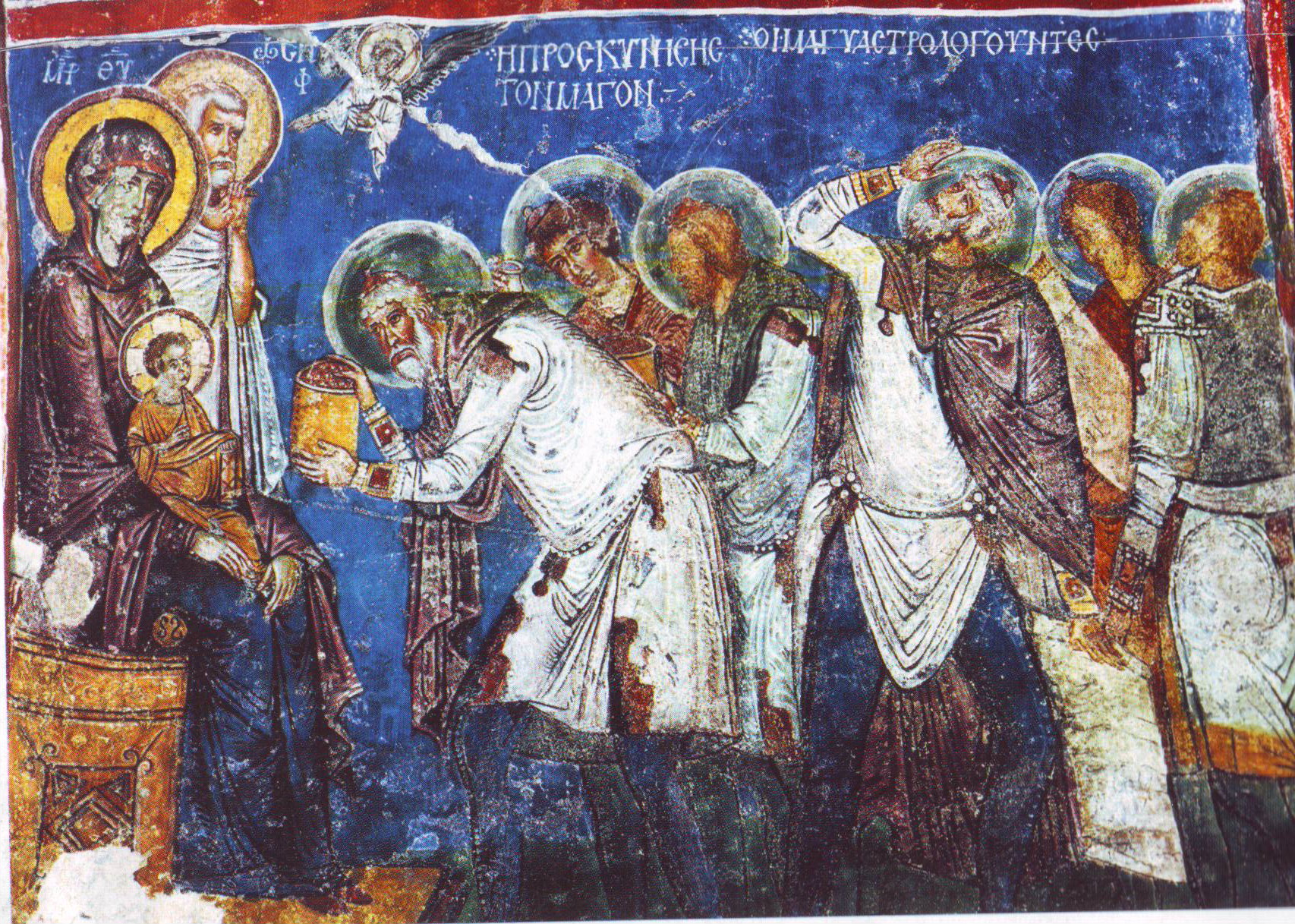
T. S. Eliot's "The Journey of the Magi"

When my mind needs to be refreshed and stimulated all at once, I turn to poetry.  The dance of well written imagery is soothing to me, and the thoughts those images inspire are vivifying.

Many of my students object to Eliot after their initial introduction to him.  His religious images are too tense or dark for them; perhaps he touches their own conflicts, which they'd rather have smoothed away in the intellectual intrigues of the Metaphysicals or the rollicking fancies of the Romantics.  I love to use this poem to show them that Eliot always has a shadowy sort of hope in his post-baptismal poetry, even when he remains brutally honest about the struggles of living in the modern world.

Here are some (very brief!) reflections on his poem, appropriate for Epiphany today . . . the italicized words are his own.  He composed it shortly after his own baptism (a very difficult period in his life).
I like these magi; they look beat up from the journey, as Eliot describes.

'A cold coming we had of it,
Just the worst time of the year
For a journey, and such a long journey:
The ways deep and the weather sharp,
The very dead of winter.'
And the camels galled, sore-footed, refractory,
Lying down in the melting snow.
There were times we regretted
The summer palaces on slopes, the terraces,
And the silken girls bringing sherbet.
Then the camel men cursing and grumbling
And running away, and wanting their liquor and women,
And the night-fires going out, and the lack of shelters,
And the cities hostile and the towns unfriendly
And the villages dirty and charging high prices:
A hard time we had of it.
At the end we preferred to travel all night,
Sleeping in snatches,
With the voices singing in our ears, saying
That this was all folly.


 No fresh-faced kings with smiling servants here . . . the Magi, like us during the Advent season, have left behind a comfortable, materialistic life [There were times we regretted . . .] in favor of a pilgrimage to a new life, a new truth.  Even their companions on the journey are disloyal [running away] and unfocused [wanting their liquor and women.]  Amidst the difficulties, the worst are the voices in their own minds that wonder if eschewing the world and taking this hard path is really worth it after all.

Then at dawn we came down to a temperate valley,
Wet, below the snow line, smelling of vegetation;
With a running stream and a water-mill beating the darkness,
And three trees on the low sky,
And an old white horse galloped away in the meadow.
Then we came to a tavern with vine-leaves over the lintel,
Six hands at an open door dicing for pieces of silver,
And feet kicking the empty wine-skins.
But there was no information, and so we continued
And arrived at evening, not a moment too soon
Finding the place; it was (you may say) satisfactory.


These images are beautiful and rich with meaning!  I'll focus your attention on a couple.  As they approach the Christ-Child, the world is temperate and thus fruitful (or potentially so).  Yet, the people there have "no information;" they are oblivious to the deeper happenings nearby.  At the same time, many of the landmarks portend dark things--the water mill is seen contending against the "darkness" and the "three trees" on the horizon portend Christ's own death on a tree with the two criminals at his side.  I also like that they find the stable "satisfactory;" they do not fall into superfluous praise or a panegyric on the irony of a god placed in a manger.  At the same time, these magi do not decide finally that "this was all folly" because the stable is merely "satisfactory" at best.  Implied may also be the sense that anything God chose for his Son must be "satisfactory" and beyond our human scale of judgement to declare otherwise.

All this was a long time ago, I remember,
And I would do it again, but set down
This set down
This: were we led all that way for
Birth or Death? There was a Birth, certainly,
We had evidence and no doubt. I had seen birth and death,
But had thought they were different; this Birth was
Hard and bitter agony for us, like Death, our death.
We returned to our places, these Kingdoms,
But no longer at ease here, in the old dispensation,
With an alien people clutching their gods.
I should be glad of another death.


A true experience of God is not easily forgotten and must be shared, as the author's insistence to "set down / This" indicates here. The next reflection on the blending of Birth and Death in the same event reminds me of Donne's very different treatment of the same theme in "Upon the Annunciation and Passion Falling Upon One Day."  Christ's Birth began the sacrifice that culminated in His innocent Death.  Our own participation in the life of Christ and our initiation in Baptism grants us a re-birth in the spirit, but that re-birth is also a death to the old self and an invitation to carry Christ's cross along with Him in this life.  The Magi witnessed the Infant Christ.  Yet, this event and their ratified belief for which they now have "evidence" from a personal encounter with God has made them strangers in their own homes.  The people they shepherded previously are "alien" to them, and the magi have the insight now to see that their faith in pagan gods is desperate.  The life of a follower of Christ is often a path of rejection; in so far as we stand up for our beliefs, we may also find that "no prophet is accepted in his own country."  But here is Eliot's sense of hope . . . the author, in the final analysis, would be "glad of another death."  Whether this refers to another meeting with Christ and metaphorical death to self or to the author's final, physical death and reunion with his Maker, it is worth the cost.  If the world sees this choice as "folly," the wise men have learned that "the foolishness of God is wiser than man's wisdom, and the weakness of God is stronger than man's strength" (1 Cor 1:25).


Image source

Friday, December 2, 2011

Language and Liturgy

This week marked the introduction of an over-due, full translation of the Latin into the vernacular English for the Catholic Mass.  I love the depth and beauty of the new language!  Responding to "Peace be with you," by saying, "And with your spirit," (instead of "And also with you") immediately helps me to focus on the fact that Christ's peace is interior and transcendent--a matter of the spirit--not a vague hope for physical comfort.

I've often heard the matter of language within liturgy and prayer debated.  Some will look to Christ's parable which contrasts the eloquent, boastful rabbi vs. the simple, sincere sinner and say that all prayer should be simple and child-like.  Christ Himself said that we must be like little children to enter the Kingdom of God.  Yet, while I would agree that rhetorical value is not to be valued over authenticity within prayer, I also think that beauty (including beauty of language) and specificity in the portrayal of truth can be an aid to prayer by engaging our emotions and our intellect in our worship.  I enjoyed some of the reflections of Fr. DeSouza on this topic.  He compares the following prayers:


For example, at Mass today we have this properly translated prayer: Stir up your power, O Lord, and come to our help with mighty strength, that what our sins impede the grace of your mercy may hasten. Compare that to the previous version: Father, we need your help. Free us from sin and bring us to life. Support us by your power.

The new translation is INFINITELY superior for reflection. I think I could use just that prayer for my reflection for the whole day . . . the power of God, His desire to assist us in our weakness, the way our iniquities prevent us from receiving His grace . . .  The first one gives me my same old complaints, a vague concept of sin vs. life, and a line about God's strength that sounds equally applicable to a Spanx commercial.  Thank God for the people who have diligently worked over the course of several years so that we could be drawn into deeper contemplation of the mysteries of our Faith!

Image source

Wednesday, November 23, 2011

Another Lost Generation (poem)

A poem written sometime earlier this year after reading too much Eliot and thinking excessively about the things we have lost in this era of technology and information.

Another Lost Generation

The music of the spheres is only heard in silence.
Remove the ear buds that will never blossom;
Tear down Babel and relearn how to hear.

Do they even know honor?
A true crossed heart and hope to die?

Under your hands the world is barren
     The seed won't flower.
     The bread fails to rise.

Do we know the way the gentlemen ride
so early in the morning?
Do we know the reason Helen cried
and filled the dawn with mourning?
Do we remember the worth of a new friend
and the old friend worth bright gold?
Do we remember the gift to Baucis
when Philemon's hands are old?

Morals and ethics not reinvented,
Permanent bonds not re-extended,

Powerless, severed from the source of Generation;
Weaker,
Groping fingers click the sign of the eternal sphere
Disrupted.


Image source